Automations allow you to streamline your work processes and save time on manual tasks. View and manage all of your automations from the Automations page i
n your site's dashboard. You can edit, duplicate and rename existing automations and deactivate those you don't need.
Viewing all of your automations
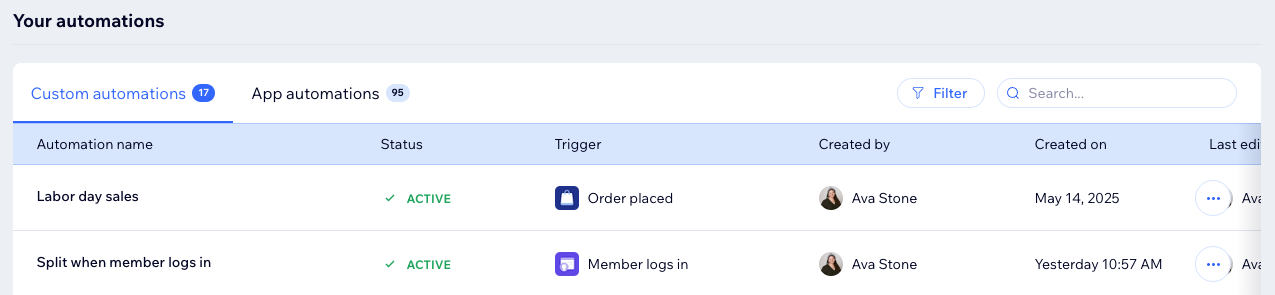
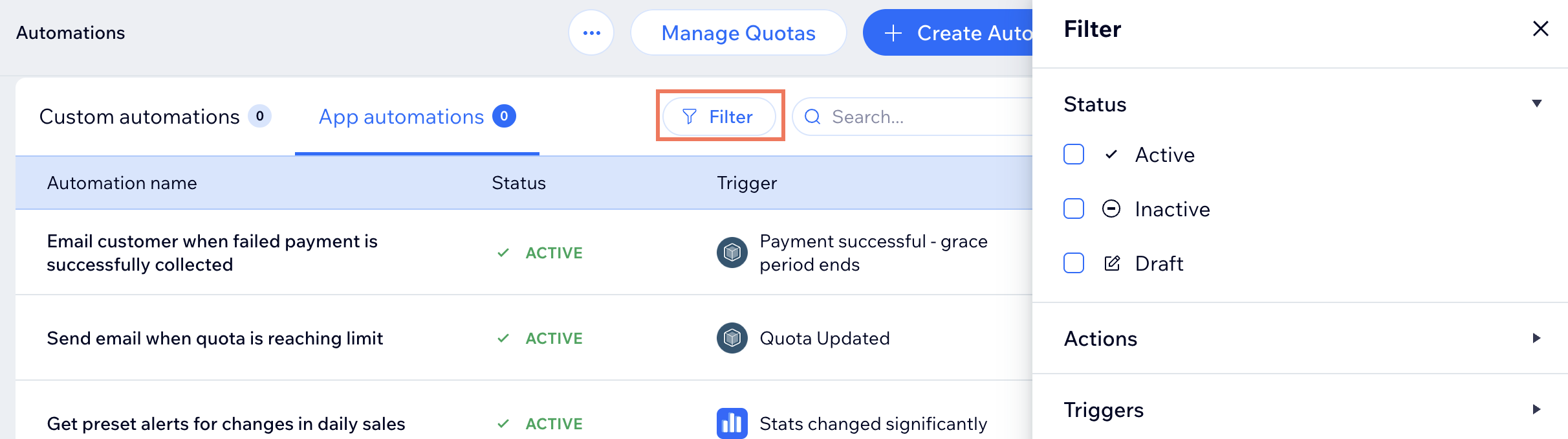
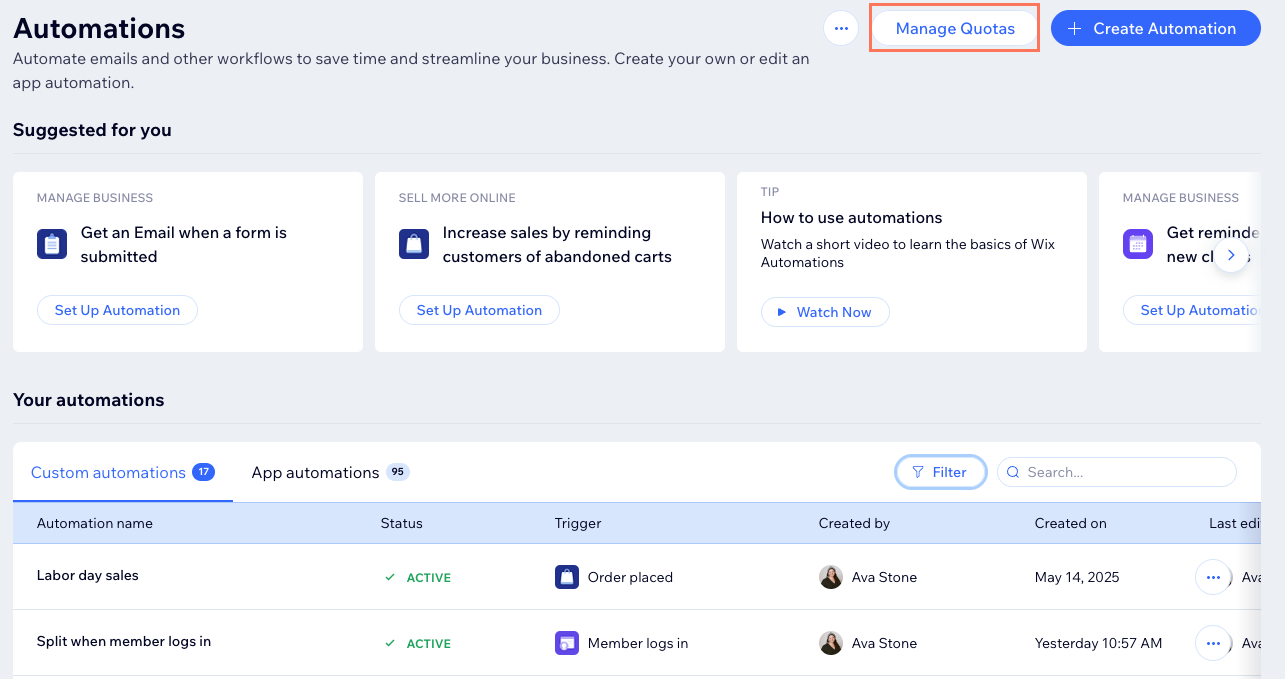
The Automations page in your site's dashboard is where you'll find a full record of all of your active and inactive automations (across all apps). The automations listed in 2 tabs: 'Custom automations' and 'App automations'.
Get details about each automation (like the number of times it was triggered), edit or duplicate automations, and more.
To view your automations:
- Go to Automations in your site's dashboard.
- Scroll down to the Your automations section to view all of your automations across 2 tabs:
- Custom automations: Active and inactive automations you've created here or directly through an app.
- App automations: Active and inactive automations created automatically when you've installed apps.
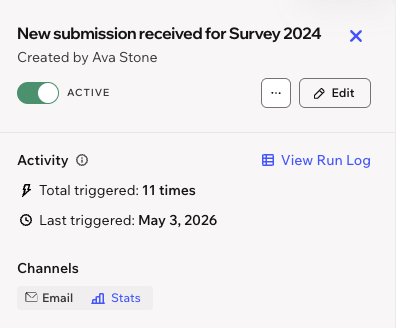
- (Optional) Click an automation to view its automation summary, the last trigger date and the total times triggered.
Editing, duplicating or renaming an automation
Edit automations so they're working for your business, or rename them so you and your site collaborators can identify them at a glance.
Save time by duplicating an existing automation and then making any edits needed. For example, you can use the same email campaign design to respond to different triggers.
To edit, duplicate or rename an automation:
- Go to Automations in your site's dashboard.
- Scroll down to the Your automations section.
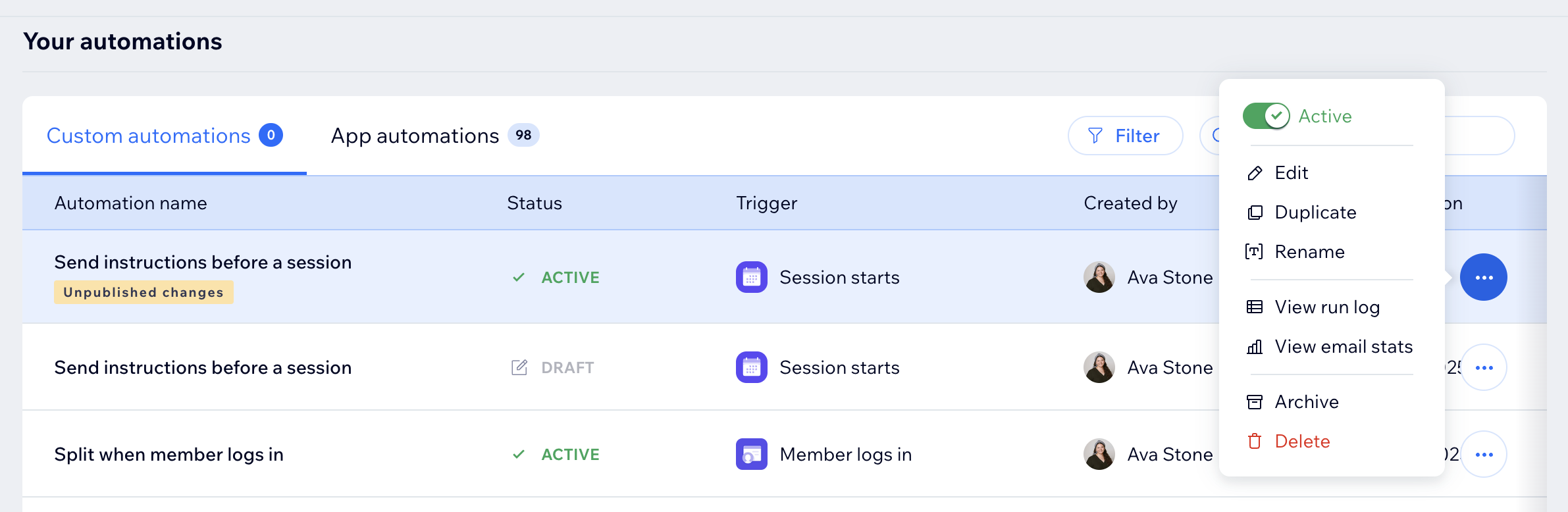
- Hover over the relevant automation and click the More Actions icon
 .
.
- Choose what you want to do:
- Click Edit.
- Edit the automation as necessary.
Tip: Click any step to duplicate, delete, skip or view its data.
- When you're finished editing, click Save.
Notes:
- Editing the timing of an automation can affect 'pending' actions. "Pending" actions have been triggered but haven't yet taken place (the delay has been set after a certain period of time).
- If you edit an automation, the changes only apply to new activations. Automations triggered before the changes were made will still run with the settings previously defined.
- Click Duplicate.
- Edit the relevant details within your duplicated automation.
Note: Don't forget to update your duplicated automation's name, or it will remain 'Copy of...'.
- When ready, click Activate.
- Click Rename.
- Edit the automation's name.
- Click Save.
Activating, deactivating, archiving, or deleting an automation
You can control the status of your automations at any time.
Activate automations you have in drafts and deactivate or delete automations you no longer require. Activating a draft will make it live and active. Deactivating an automation will make it inactive, ready to be activated again in future.
Archiving an automation will set its status to inactive and prevent any future runs. Deleting an automation will remove it from your page and you won't be able to restore it.
To activate, deactivate, archive or delete an automation:
- Go to Automations in your site's dashboard.
- Scroll down to the Your automations section.
- Hover over the relevant email automation and click the More Actions icon .
- Choose what you want to do:
- Click Edit.
- Click Activate at the top right.
Deactivating an automation will stop it running without deleting it. You can reactivate at any time.
Click the toggle to deactivate an active automation.
Notes:
- If you deactivate an automation, any ongoing runs stop and any pending actions are cancelled.
- Trigger data isn't collected when an automation is inactive. The automation won't run retroactively when reactivated.
For example, an automation that sends "thank you" emails following purchases is deactivated on Monday. Joe makes a purchase on Tuesday. The automation is reactivated on Wednesday. Joe won't receive a "thank you" email because the automation couldn't collect the trigger data on the day of Joe's purchase.
- Click Archive.
- Click Archive Automation in the pop-up to confirm.
Notes:
- If you archive an automation, runs in progress will not be affected and pending actions will execute. Keep in mind that you cannot edit an automation while it is archived.
- You can restore an archived automation and return it to your list of active automations. The unarchived automation is restored as 'inactive', so you can make it active again whenever you’re ready.
- Archived automations are permanently deleted after 6 months.
- Click Delete.
- Click Delete in the pop-up to confirm.
Notes:
- If you wish to use an automation in the future, consider deactivating it rather than deleting it.
- App automations cannot be deleted but often can be deactivated.
- If you delete an automation, any ongoing runs stop and any pending actions are cancelled.
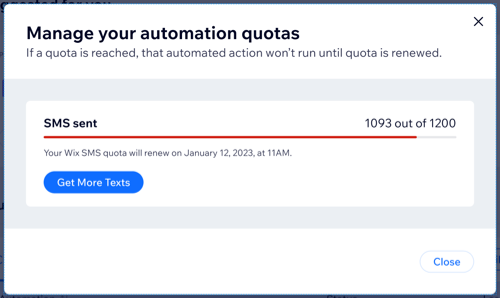
Viewing your quotas
Some automation actions are subject to quotas. For example, an automation with the action 'Send an email' uses emails from your site's
email marketing plan. View your quotas from your Automations page so you can easily see when your quotas are running low and you might need to upgrade.
To view your quotas:
- Go to Automations in your site's dashboard.
- Click Manage Quotas.
Viewing your email automation statistics
Automations with the ‘Send an email’ action include a dedicated statistics page. Track email performance, filter by date range, and see a list of all recipients.
To view your email automation statistics:
Go to Automations in your site's dashboard.
Scroll down to the Your automations section.
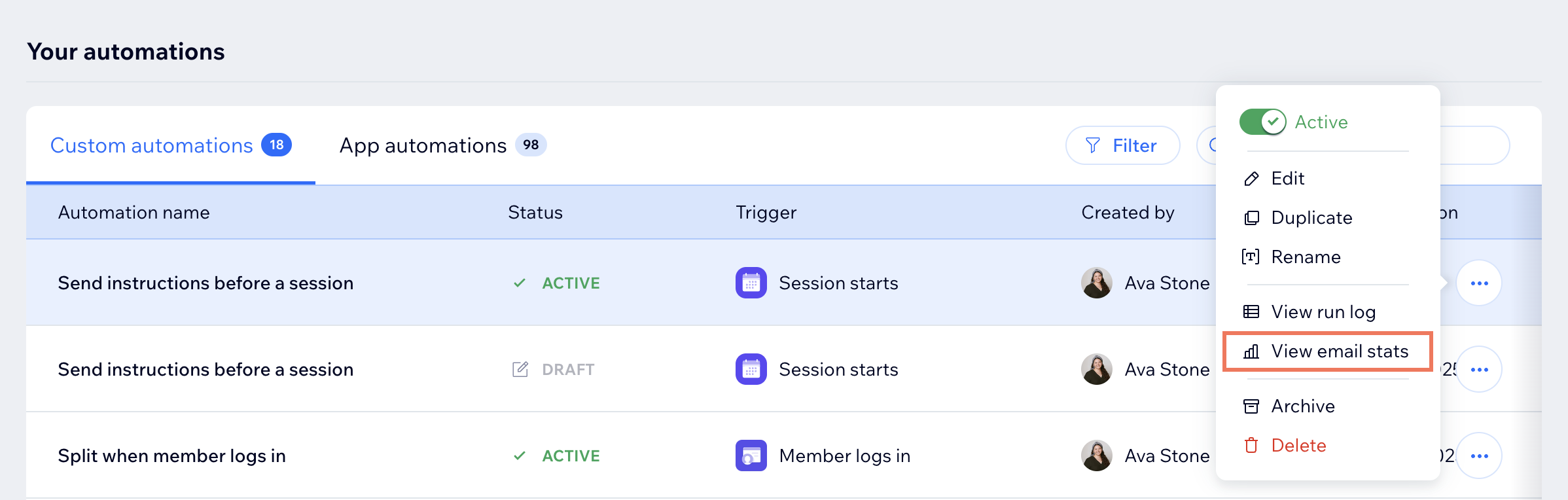
Hover over the relevant email automation and click the More Actions icon .
Click View email stats to view your email marketing statistics.
Go to the relevant tab:
Email analytics: Filter by date range to view the following statistics.
Delivery statistics: How many emails were sent, plus delivery rate, open rate, and click rate. Each metric shows both the total number of emails and the number of unique recipients.
Business impact: Sales and orders from recipients who clicked through.
Site traffic: Site sessions and unique visitors driven by the email.
Delivery performance: Bounced emails, spam complaints, and unsubscribes.
Top links clicked: URLs in your email ranked by unique clicks.
Recipient: Allows you to see anyone who has ever received the email. Filter by status (e.g. Sent, Opened, Clicked) and/or download the list.
Viewing your automation's run log
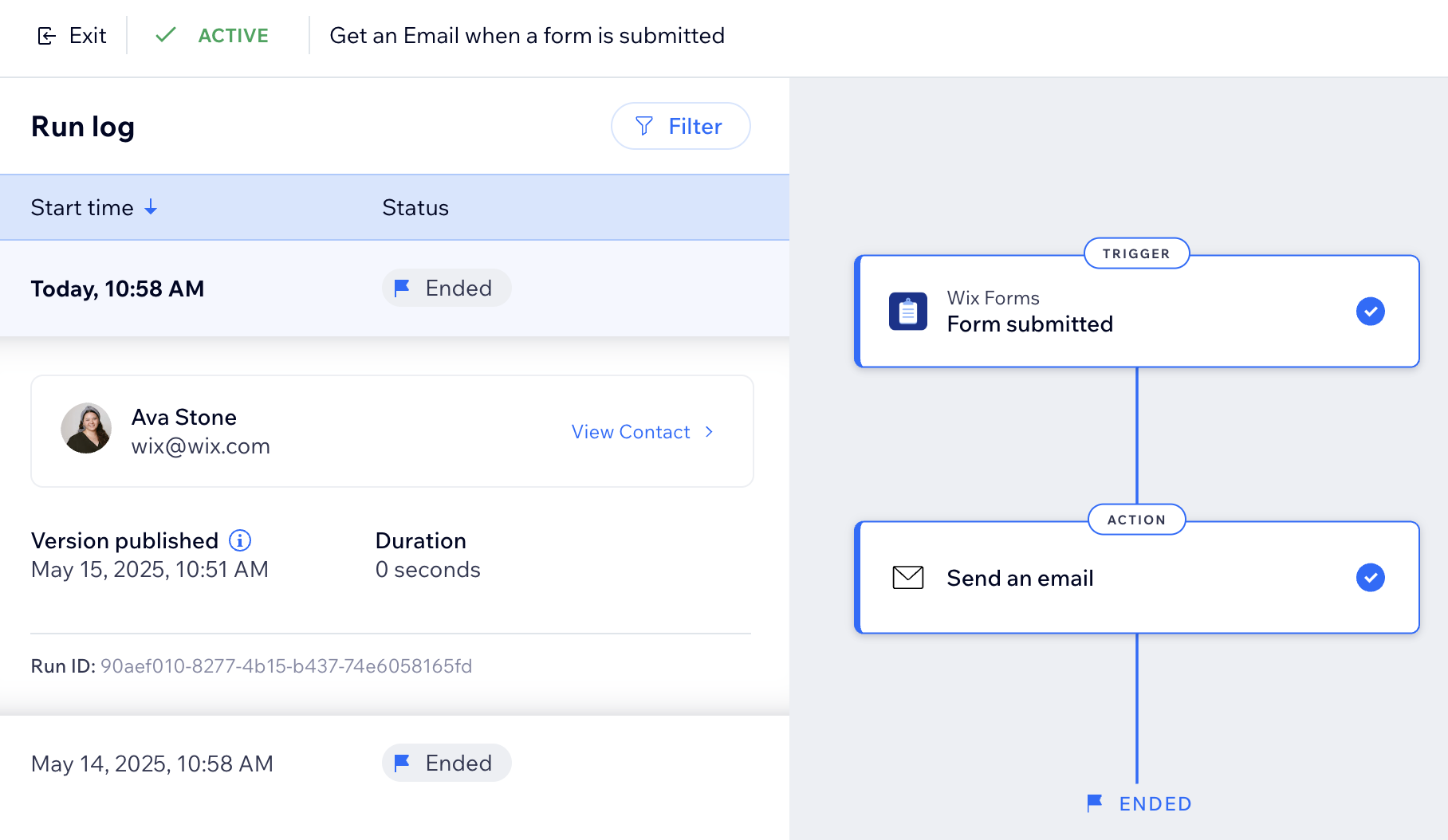
The run log is designed to give you detailed insights into how your automation operates. Each time an automation is triggered, the run log presents vital information such as the status of each run, how it performed, and whether there were any issues along the way.
This helps you monitor the success of your automations and identify potential problems, in order to fine-tune your workflows and ensure they run smoothly.
To view your automation's run log:
- Go to Automations in your site's dashboard.
- Scroll down to the Your automations section.
- Hover over the relevant email automation and click the More Actions icon .
- Click View run log to view the runs from this automation.
FAQs
Click the questions below to learn more:
What is an 'App automation'?
As you build your site and install apps on it, some apps include complimentary automations that are important for the proper functioning of these apps. Some automations are installed on your site upon the app’s installation, and some are installed upon specific events.
Are there suggested automations?
Yes. You'll see Wix's suggested automations when you start to create a new automation. These are specific to your business type and the apps you've added to your site. They are listed by business benefit to help you choose: "Sell more online", "Engage with clients", and more.
Where can I find my archived automations?
- Go to Automations in your site's dashboard.
- Click the More Actions icon
 at the top.
- Click Archived Automations to view all your archived automation workflows.
What happens to the data and statistics of an automation after it’s archived?
All email stats and run logs remain accessible while the automation is archived. You can view these from the Archived Automations table at any time until the automation is permanently deleted after 6 months.
What happens if I skip a step in my automation?
The Skip feature lets you temporarily disable a step while keeping it in your automation flow. This means that a skipped step won’t run when the automation is triggered.
Note: Conditions can't be skipped.
What statistics can I see for all my automations?
For all automations that do not have a 'Send an email' action, you can view the last triggered date and the total times triggered. Click the relevant automation on your Automations page to display the summary panel.